Author: pearla.antoun14@gmail.com

  • Assignment 3 – Question 4

    4. For question #2, what did you do differently from the original post? Please outline, explain and justify what you changed & why. Essentially, what did you learn from this new topic and what did you change and why.

    In the revised version I’ve made several changes to improve the post’s organization and clarity based on the F-pattern and plain English writing concepts we covered in class. In my initial post, the opening began with a description of the studio but it didn’t really draw readers in or provide a clear explanation of the business’ offerings. The new headline can quickly tell readers what Spotlite Photography is and what makes it special. 

    In addition, I reorganized the content so that the most important information is at the top of the post. This includes what the studio is about, its location, and what makes the experience unique. This update follows the f-pattern better since readers usually focus on the top and left side of the page when scanning content. 

    Another change I made was using headings and bullet points to improve scannability. The majority of the content in the original version was written in paragraph form making it difficult to quickly scan information. When the content is divided into sections and uses points with short sentences it makes it easier for readers to find what’s important.

    Lastly, I included a clear call to action to urge readers to schedule a session. This provides them with guidance on what to do after learning about the studio. Overall, these changes help (hopefully)  improve the post’s scannability, effectiveness and clarity for web users.

  • Assignment 3 – Question 3

    3. For question #2, explain how your new post successfully addresses the three main objectives of Plain English writing as discussed in class. Provide a detailed breakdown of each objective.

    a. Describe one specific technique you used to improve readability in your revised version and explain why it is effective.

    A technique I used in my revised version was using headings and bullet points to organize the copy and make it easier to read. The updated article text divides important information into sections such as “What is Spotlite Photography?” and “What Makes Spotlite Different?” rather than writing it in a lengthy paragraph. I also used the feedback given on the assignment to bold important phrases that stand out and summarize the text and give full context without reading every single word. This will help readers to quickly scan the page and identify what’s most important to them. 

    This technique works well because online readers usually scan text instead of reading every word. When headers and lists are used they highlight key information and make the content easier to understand and navigate through. This method of organizing content improves readability and allows users to find important information quicker.

    b. What was the most challenging aspect of applying the F-Pattern and Plain English writing principles? How did you overcome it?

    The most challenging aspect of using the F pattern was deciding which information should come first in the introduction. Although the studio was described in the original version it didn’t clearly present the most important information in the beginning and sounded a little vague. 

    To overcome this, the updated version includes the 5W’s in the headline and opening paragraph such as what Spotlite Photography is, where it is and what makes it different. This ensures that when readers scan the page, they will quickly understand the company’s purpose. This approach follows the F pattern structure where readers focus mostly on the first 2 sentences and the top and left side of the page. 


  • Assignment 3 – Question 2

    2. In a previous assignment, you wrote an introduction article in the “F” pattern. Based on what we discussed in class and based on the feedback provided in class, write a new introductory “content” incorporating “plain English writing for the web” in the “F” pattern including visuals. You are to include your “revised version” (if the version you submitted was not in the F-Pattern). Ensure that it addresses the three main objectives of plain English writing. As a reminder, this is an introductory post for your business. Ensure you list it in your hardcopy.

    Original article:

    A Private Self Portrait Studio in Windsor, Ontario

    Spotlite Photography is a private, self portrait photography studio based in Windsor, Ontario. Designed for those seeking high quality pictures in a comfortable, stress free space. A studio created with you in mind where you’re in control of the entire experience and can use our professional photography equipment to take your own photos on your own time in a way that feels natural. 

    Take your Time, Take Your Photos

    Spotlite is the first free-form self directed studio in Windsor, which means sessions are timer based and you decide how you show up. Not everyone can be comfortable in front of a photographer and that’s why we exist. Once everything is set, you’re free to move, experiment, and settle into the moment. 

    Whether you’re booking a session for yourself, family, friends, or a loved one, the experience is designed for you to create something that feels like you. If something doesn’t feel right, you adjust and try again. 

    What Makes Spotlite Different

    • A private self directed studio designed for comfort, and zero outside distractions.
    • Timer based photography that provides you with full creative control.
    • Beginner friendly professional equipment made easy for you with a simple press of a button.
    • A relaxed environment ideal for individuals and small groups.

    What Can you expect

    The process itself is simple. After booking your session you’ll be shown how everything works, then you’re given the freedom and space to create. It’s straightforward, easy to use and made to be enjoyed from start to finish. 

    Ready When You Are

    If this sounds like you, Spotlite will help you capture your most natural self in a private space here in Windsor. Here when you’re ready to take the Spotlight and experience our free form photography.

    Revised article:

    Take Control of Your Photos at Windsor’s First Self-Directed Studio

    Are you looking for a photography experience where you’re fully in control? Spotlight Photography is a private self-directed studio in Windsor, Ontario where you can take quality pictures at your own pace in a comfortable relaxed environment. 

    Whether you’re capturing moments with friends, family or just yourself, Spotlite provides you with professional photography equipment without the pressure of a photographer in the room. You’re in full control of the camera, poses, and the entire experience. 

    What is Spotlite Photography?

    Spotlight Photography is Windsor’s first free-form self-directed studio. Unlike a traditional photoshoot, your session is timer-based so you can move at your own pace. Not everyone feels comfortable in front of a photographer which is why Spotlite was created, to give people a stress-free option to capture photos in a natural private setting.

    What Makes Spotlite Different?

    •  Private studio space with no outside distractions.
    • Timer based camera system that provides you with full creative control.
    • Self-directed photography sessions so you can control the experience.
    • Beginner friendly professional equipment that’s simple to use.
    • A relaxed environment ideal for individuals, couples, and small groups.

    What to Expect During Your Session?

    The process is designed to be simple and direct for ease of use.

    1. Book your session online.
    2. When you arrive at the studio you will be shown how the equipment works.
    3. Once you’re ready the studio will become your own creative space.

    Ready to Step Into the Spotlight?

    If you’re looking for a fun simple way to take professional photos, Spotlight Photography is ready when you are.

    Book your session today and experience Windsor’s first self-directed studio.
  • Assignment 3 – Question 1

    1. We spoke about Plain English writing in class. Please answer the following in detail:

    a. How would you explain to someone what “Plain English writing” is?

    Writing in plain English makes it easier for readers to grasp the message when reading something for the first time. It encourages the use of common everyday language, brief sentences and a logical structure that makes the content easy to understand. Plain English writing emphasizes clarity and making material understandable to the reader rather than using complex vocabulary or unnecessary terminology. (Briscoe, W8 – Plain Language Writing (W26).pdf, Slide 2)

    The primary goal of plain English writing is helping readers quickly understand the message and find the information they need. This involves organizing information in a clear format, putting the most important point first and focusing on the reader’s need rather than what the writer wants to say, meaning explain the topic in the most straightforward way possible and avoid rambling. (Briscoe, W8 – Writing Website Copy & Plain Language Writing (W26).pdf, Slide 8)

    b. What makes plain English writing different?

    Writing in plain English is different because it puts readability and clarity first for the audience. It focuses on making information simple to read and comprehend rather than using complex language or lengthy explanations. 

    Plain English writing uses simple language, short sentences, and a clear structure to help readers easily understand the content. Additionally, it avoids unnecessary phrases and technical terminologies and encourages the use of the active voice. Moreover, the content is organized using headers, lists, and short paragraphs to make it easier for readers to find important information. (Briscoe, W8 – B – Plain Language Writing Tips (W26).pdf, Slide 3)

    c. What is plain language writing for the web and in detail and in your own words, why is it important?

    Plain language writing for the web means presenting information in a style that makes it easy for people to find what they need, grasp it, and use it to fulfil their purpose. Clearly written and well organized content makes it easier for readers to navigate websites and understand the content without confusion. (Briscoe, W8 – A – Plain Language Writing (W26).pdf, Slide 18)

    This is important because people typically scan the websites to find what they need rather than reading every word. Users will quickly click off the page if the content on it is confusing or unclear which can negatively interfere with the customer journey and conversion rates. Therefore, plain language improves readability, accessibility and user experience by making information simpler to understand and act on. (Briscoe, W8 – Writing Website Copy & Plain Language Writing (W26).pdf, Slide 3)

  • Part B – Question 4

    Create one headline promoting second-year digital courses in this program, targeted to first-year students.

    You must provide:

    a) Provide the headline

    Ready To Level Up? Here’s How The Second Year Digital Courses Will Prepare You For The Real World

    b) Explain your reasoning clearly using class content

    As first year students are learning foundations and fundamentals they are definitely thinking about their future in the program. Therefore, this headline acts as a decision trigger which is the primary job of a digital headline as described. “Ready to level up” engages them in thinking forward and suggests a subtle challenge by promoting an internal response. 

    The phrase “here’s how” promises value to them by signaling clarity and usefulness. It promises an explanation which aligns with how headlines must communicate relevance and lessen doubt. It assures students that there’s something to gain which is preparing them for the real world. Instead of simply listing digital programs like saying SEO or email, it highlights real world readiness. The message centers on students’ benefits making it audience driven rather than program or courses. 

    It also introduces a curiosity gap, encouraging them to open up the article and read it to know how they can level up. This combines engagement with clarity which is crucial for digital readers who make decisions within instants. 

  • Part B – Question 3

    Create one headline for an article about the SCC Advertising Program, targeted to local graduating high school students.

    You must provide:

    a) The headline

    Turn Your Creativity Into a Career: The Top 5 Reasons Why SCC Advertising Program Might Be​​ The One For You

    b) An explanation of the information missing from the instructions

    • The information missing from the instructions are things such as the program’s career rate, internships, or USP that would make it stand out. 
    • Doesn’t specify the goal of the headline. Is it awareness, applications, or open house attendance.
    • Doesn’t provide data or stats that can be used.
    • Whether tuition affordability is an important factor.
    • Doesn’t say if digital skills should be highlighted or the main focus or applications used in this program.what makes it different from other schools or programs. 

    c) A detailed justification for your headline choice based on course concepts

    This headline works as a decision trigger. It brings forward an opportunity right away by framing the program as a pathway that leads to a career. The phrase “turn your creativity into a career” provides the reader with a value and assures them of an outcome to reduce cognitive friction telling people why they should care. 

    It also signals relevance, since we’re writing the headline to graduating high school students who are often conflicted or uncertain about what paths would guarantee them jobs. Including number 5 applies to the concept of the importance of using numbers (it can be changed based on the amount of reasons provided in the content). Numbers help readers by making the information sound more trustworthy and digestible, aiming to help lessen cognitive friction. 

    By saying that the program “might be the one for you” allows for a curiosity gap without overpromising. It tells the reader that it might be for them if they read the content to determine that. It suggests evaluation rather than forcing a decision that may not align with them which might feel persuasive and manipulative. Overall, the headline balances value, clarity, structure, and appeal without overpromising or misleading the reader. 

  • Part B – Question 2

    Choose one headline you created in Part B, Q#1 Part B and answer the following:

    Headline 2: 5 Statements From the US Men’s Hockey Players On Why They Rejected The White House Invite And *That* Phone Call Sparking Backlash.

    a) What is the primary intent of this headline? (e.g. curiosity, urgency, clarity, relevance, emotional pull)

    The primary intent of this headline is to combine clarity with curiosity driven engagement. The use of number 5 reflects organization and structure which makes the information seem digestible and realistic. The line “that phone call sparking backlash” also creates a curiosity gap and emotional tension. Although the headline suggests controversy, it does not provide a complete explanation of what happened. 

    The main intent of this headline is to:

    • Trigger curiosity.
    • Signal informational value.
    • Highlight a conflict, suggesting drama to help increase engagement. 

    b) What action or response is the headline designed to trigger?

    The headline is intended to trigger an immediate click decision. According to class discussions, the headline in digital spaces is supposed to act as a decision trigger that readers process through system 1 thinking which should be fast, emotional and automatic. The goal is to get the reader instantly engaged and click. 

    The action that the headline is designed to trigger is:

    • Click to fill in that curiosity gap
    • Read to understand the what and the why that the phone call insinuates. 
    • Stay engaged with the content structured in a list, easy to read format. 

    c) Explain why this intent is appropriate for the target audience you selected.

    The target audience for this article is most likely people who are socially engaged and consume trending media regarding sports and political culture content, which are the qualities found in BuzzFeed’s target readers. 

    These users are:

    • Fast scanning, read multiple things at the same time to stay in the know.
    • Socially aware.
    • Drawn to some drama and controversy.
    • Looking for shareable content.

    Digital users are very often distracted and could be considered impatient meaning the headline should immediately signal value and relevance to them in seconds before they decide if it’s worth reading or not. 

    The use of numbers to help with structure and scannable content and the emotional element of the backlash is combined with “that phone call” to create curiosity all working together to engage the user without fully revealing the outcome. 

  • Part B – Question 1


    Using the article from Part A, Question #1, you are to create three (3) different headlines. Each headline must emphasize a different headline element discussed in class.

    For each headline:

    Headline 1:

    a) Include the Headline

    The Real Reason why these 5 Hockey Players Skipped the Invitation of US President to the State Of The Union.

    b) Explain your reasoning

    This version uses the phrase “the real reason” and removes the detailed explanation. In doing so it creates a knowledge gap by withholding certain information. It simply suggests that there’s a reason without providing lots of explanation which would encourage the reader to click in order to clear up that uncertainty. 

    c) Reference specific class concepts

    The curiosity gap is highlighted in this headline which was covered as a psychological trigger that causes readers to want to close an information loop. By suggesting that there’s a “real reason” as to why they “skipped” it creates missing information that the reader’s brain will want to fill in and according to class notes it uses a unique rationale. It makes it depend on natural emotional curiosity. The title communicates interest and relevance without overloading the reader with information, lowering friction and encouraging fast clicks. 

    Headline 2:

    a) Include the Headline

    5 Statements From the US Men’s Hockey Players On Why They Rejected The White House Invite And *That* Phone Call Sparking Backlash.

    b) Explain your reasoning

    This headline uses a clear structure by leading with a specific number and it works perfect for this one because there are in fact 5 statements and as we discussed in class the use of odd numbers makes people trust it more. The number 5 signals that the article is organized and easy to digest. Instead of making it sound like a general commentary it makes the content feel like concrete statements making the information feel more intentional. Including “that phone call” adds a hint of something intriguing and the “backlash” creates tension and encourages curiosity. 

    c) Reference specific class concepts

    The headlines highlight the effectiveness of using specific numbers which are “brain candy” for people because they make it easy for the brain to process. They also increase CTR and make content feel more structured and legit.

    It also uses a unique rationale in “statements” which can align with the concept of communicating a benefit to the reader. Then it taps into emotional triggers with the “backlash” which attracts immediate attention. It still signals value and relevance while accurately reflecting the content.  

    Headline 3:

    a) Include the Headline

    Here’s Why The US Men’s Hockey Players Declined The State of The Union Invite And What Happened Next

    b) Explain your reasoning

    This headline focuses on clarity and logical progression. It communicates the issue of “why” and then it introduces another element “what happened next”. This one doesn’t really rely on emotional triggers or language but it builds curiosity through structure. The “what” creates a subtle hook. It almost states that there are consequences without saying what it is. This encourages people to want to read to find out the outcome of the decision. 

    c) Reference specific class concepts

    This headline emphasizes clarity and signals value, aligning with the idea that it must reduce friction and quickly communicate relevance. It communicates to the reader exactly what the article will be about making it easy to process. It also reflects the structure of the content in the article of why they declined and the reaction. Lastly, the “what” creates a subtle curiosity gap to help encourage engagement without misleading the reader. This makes it effective while maintaining credibility.

  • Part A – Question 3

    a) Provide a different headline you recently clicked on.

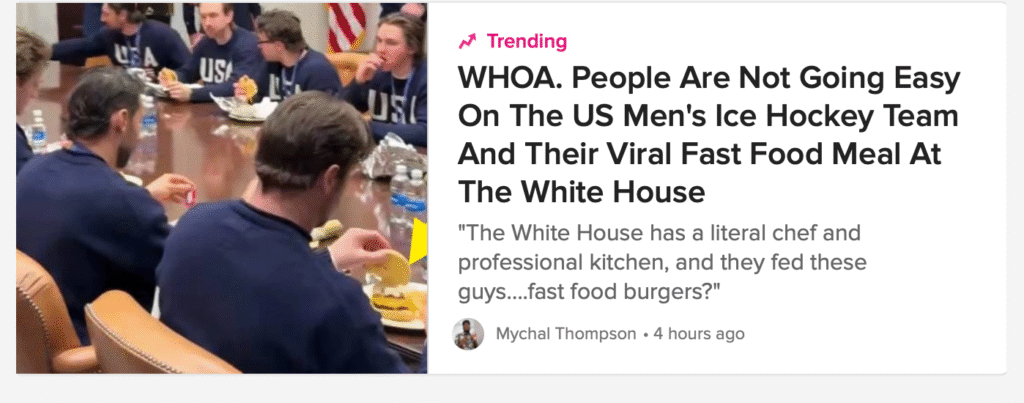
    “WHOA. People Are Not Going Easy On The US Men’s Ice Hockey Team And Their Viral Fast Food Meal At The White House”

    Found this headline just a couple scrolls after the first one. 

    b) Include the exact headline and a screenshot

    c) Explain why you clicked it, not why you liked it

    I clicked this headline because it seemed very intriguing for me and it triggered a reaction that made me feel like I missed something big regarding the situation. The first word being “WHOA” is all caps felt dramatic and signaled that something unexpected happened, almost like saying, hey this is something you should read. It gave the sense that something shocking or controversial happened and I didn’t want to be out of the loop. 

    The phrase “people are not going easy” made it sound like there’s some sort of criticism and backlash happening which naturally drew my attention, curious to know what the conflict is about. Also having prior knowledge about the situation made me want to know what else they did that caused another strong reaction. Also the mention of “fast food meal at the white house” made it sound ironic and felt slightly unusual and almost ridiculous. The combination of politics and sport especially right during this politically charged times made the headline feel socially relevant and conversation worthy. 

    I didn’t click because I cared about the US team, I clicked because the headline created tension and left out key details which made it feel like it would almost be like reading gossip in a group chat and want to understand what the reaction is about. 

    d) Tie your reasoning directly to course concepts

    The headline used a curiosity gap by giving incomplete information. It didn’t explain why people are upset, it just says that they are. This makes readers such as myself curious which according to our class discussions makes us want to click to fill in that gap and find out missing details. 

    Starting the sentence with “WHOA” used emotional trigger language that immediately grabbed my attention engaging system 1 thinking being fast and automatic. 

    Also the topic involves a national sport, the white house, and public reactions which are all elements of social relevance and conflict. Headlines that hint at controversy or disagreement tend to perform well because everyone’s interested in a little drama that taps into social dynamics and public opinions. Also the promise of a “viral” moment suggests that the article is relevant, trending and contains shareable content making clicking feel worthwhile. 

  • Part A – Question 2

    Was the headline in Question #1 an accurate representation of the article content?

    a) Explain your reasoning clearly

    Yes it was. The article content stated clearly what each team member said and their reason and it even revealed their political stances. The article revealed statements and reactions from each of the five members who skipped the State of the Union including details surrounding the invitation. The headline didn’t exaggerate the situation or implied something that wasn’t covered. Rather it provided a clear topic and expanded on it in the content’s body copy. The headline directly reflects the structure of the article by focusing on individual responses and the mysterious “phone call” is explained in the article, meaning the curiosity they created in the headline is stated and resolved rather than leaving the reader feeling misleaded.  

    b) Reference course discussion on misleading vs effective headlines

    In class we discussed how headlines act as decision triggers in the digital environment meaning if it misrepresents the articles, the readers will naturally lose trust and bounce. This headline avoids this because it accurately represents the body copy rather than using some dramatic clickbait that isn’t supported. 

    It also used curiosity gaps which are psychological tools that can encourage engagement. In this case the gap is resolved which makes it an effective headline. The headline accurately mirrors the article since the content focused on players reactions and statements regarding the situations on why they didn’t attend. The headline was able to balance between curiosity and clarity which made it effective rather than misleading.